
B2B FAQ: MOQ, Lead Time, QC, and Export
Regular MOQ for standard monoblock and 2-piece forged wheels is 4 units, with mixed-batch sampling for common specifications. Custom finishes, special colors, or engraved logos may require a higher MOQ—contact us to align a small-batch or pilot program.
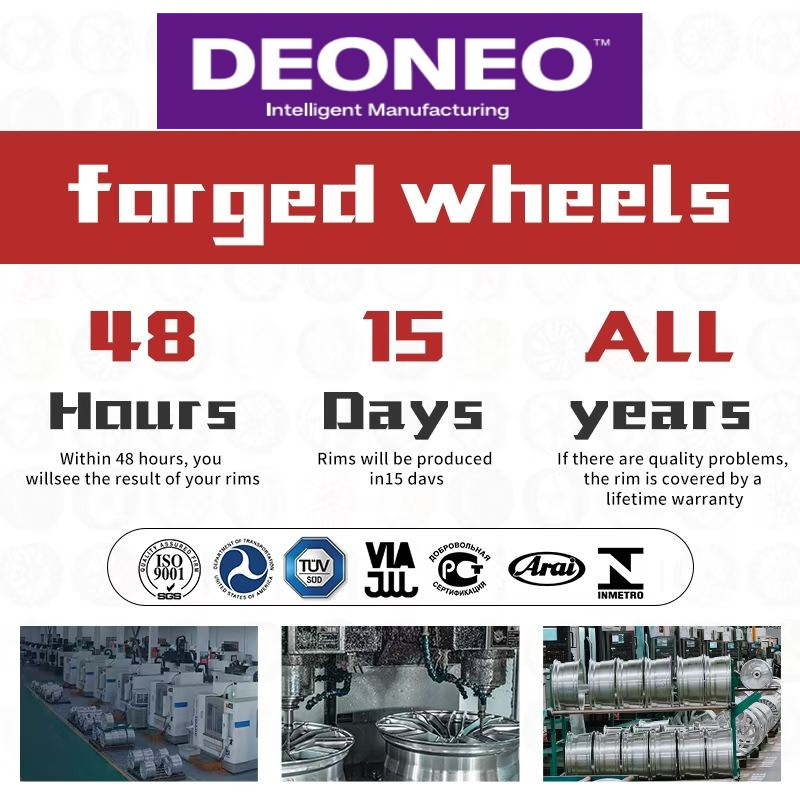
Typical production lead time is about 25 working days for standard monoblock wheels and about 30 working days for 2-piece structures, after final drawings and specifications are confirmed. Peak-season custom programs may require a confirmed production slot.
T/T is most common: a 30% deposit to schedule production, with the balance before shipment. L/C can be discussed for larger-value programs. Sample and pilot orders for new partners can be negotiated case by case.
For volume programs, sea freight (FCL/LCL) is usually the most cost-efficient. Air freight is available for urgent replenishment. DDP door-to-door service can be arranged for selected regions—aligned with your incoterms and customs needs.
Claim Your Complimentary Consultation Now.
Other Questions
Technical & Payment Question
Yes. We support color development, logo engraving, center caps, offset/PCD within engineering limits, and export packaging. Share drawings or a specification sheet; we can quote accurately and sign an NDA when required.
Products carry a 1-year after-sales warranty for non-human quality issues, with repair or replacement subject to inspection. Damage from improper installation, collision, or unauthorized modification is outside warranty scope.
Each wheel is protected with bubble film and packed in export cartons to reduce handling damage—aligned with routine international transport requirements.
We supply standard export paperwork such as packing lists and commercial invoices, plus certification or test documentation as agreed for the destination market, to support smooth customs clearance.
DEONEO operates 500 three-axis CNC machines, 31 precision lathes, and an automated line with about 800,000 units annual capacity, with polishing throughput of roughly 20,000–30,000 units per cycle—supporting stable batch quality for wholesale programs.
We cross-verify forging die flow simulation across software tools and adjust parameters using long-term forging expertise—reducing porosity risk and locking in optimal process conditions before tools cut metal.
We program machining with advanced CAM for complex 3D curvatures and tight tolerances—matching the precision demands of premium forged alloy wheels and custom rims programs.
Polishing capacity reaches roughly 20,000–30,000 units per production cycle, supported by dedicated polishing stations, cloth-wheel polishers, and water polishing equipment for consistent surface preparation before coating.
Robotic arms across the coating line automate gloss and appearance control. For complex designs we combine masking, machining, laser engraving, pad printing, and HRNT to meet diverse finish specifications.
Forged wheels are validated through rigorous radial, impact, and bending testing protocols, supporting stable performance at speed—aligned with our lightweight, high-strength product positioning.